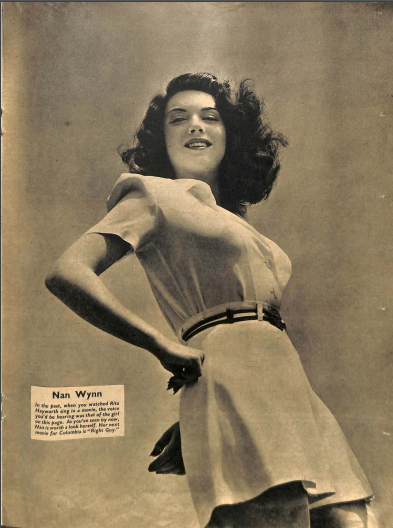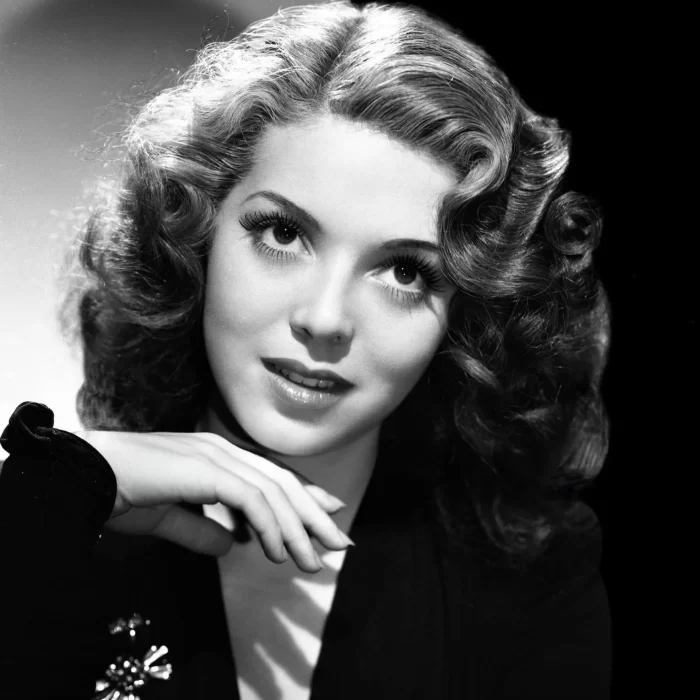
b. Masha Vatz, 8 May 1915, Wynn was born in Johnstown, Pennsylvania, and grew up in Wheeling, West Virginia, where she attended high school, and sang in the school choir. Her father, Abe Vatz, owned a department store in Wheeling, and traveled often to New York.. At the age of 16, while spending a weekend in New York City with her mother, Wynn’s singing came to the attention of a retired producer who was a guest at the same place. He booked Wynn at a Peekskill vaudeville house, the owner of which engaged her to sing at his two other New York State properties, in Kingston and Newburgh. After working the vaudeville circuit, the late 1930s saw Wynn landing at radio station WNEW in New York for a 13-show-per-week stint and honing her talent under the mentorship of Jimmy Rich, the singing coach to Dinah Shore, and Bea Wain, among others. Wynn had a smooth, soft-voice and moved to New York in her teens and joined the Will Hudson – Eddie De Lange Orchestra, featuring on its 1937 hit records ‘Yours and Mine’ and ‘Popcorn Man’. She then went on to sing with Hal Kemp (‘What’s New?’) and Raymond Scott (‘And So Do I’). She also sang with Emery Deutsch, Rudy Vallee, Eddie Duchin, Richard Himber, Teddy Wilson and Freddie Rich orchestras. For about nine months early in her career, she performed as Suzanne.
In the late 30s, she appeared on her own radio show, and with Hal Kemp on Time To Shine (also known as The Griffin Program) which was a popular musical variety radio program broadcast on the CBS network sponsored by the Griffin Shoe Polish company.
In the early 40s she featured in several movies, and she was one of the vocalists who dubbed the singing voice of Rita Hayworth. Because several women performed that function, including Anita Ellis, Martha Mears and Jo Ann Greer, there is often confusion as to who sang for Hayworth in any particular film, but it seems likely that Wynn did the honours in You’ll Never Get Rich (1941), and You Were Never Lovelier and My Gal Sal (both 1942). She also appeared as a pin-up girl in Yank magazine in 1943. In 1944 Wynn appeared on Broadway in the Billy Rose revue The Seven Lively Arts, and introduced one of Cole Porter’s most bitter-sweet ballads, ‘Ev’ry Time We Say Goodbye’. In the late 40s she sang mostly in clubs and small theatres.
In the late 1940s, she appeared on the Morey Amsterdam and Ed Sullivan shows. Wynn’s career was cut short abruptly in 1949 by the loss of her voice following the surgical removal of a cancerous tumor, which resulted in a severed facial nerve. Refusing to accept the medical prognosis that a recovery was not possible, Wynn regained her speech and facial control by 1955, at which point she was briefly signed to RCA Victor. She died from cancer in 1971.
Films
Wynn appeared on the silver screen, often as a nightclub singer, in such films as Million Dollar Baby (1941) with Ronald Reagan, Pardon My Sarong (1942) with Abbot & Costello, Right Guy, (1943), Princess O’Rourke (1943) which starred Olivia De Haviland, Is Everybody Happy? (1943) which was effectively a biopic of Ted Lewis and his Orchestra, Jam Session (1944) featuring Alvino Rey’s Orchestra and Intrigue (1947) with Gerorge Raft. She had a starring role opposite William Lundigan in the 1941 film A Shot in the Dark (1941).
Appetizers