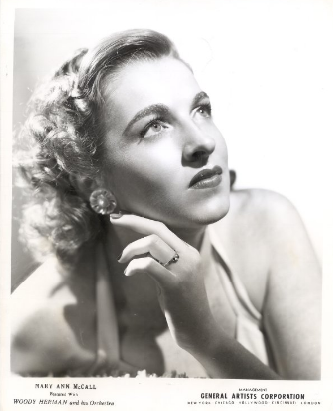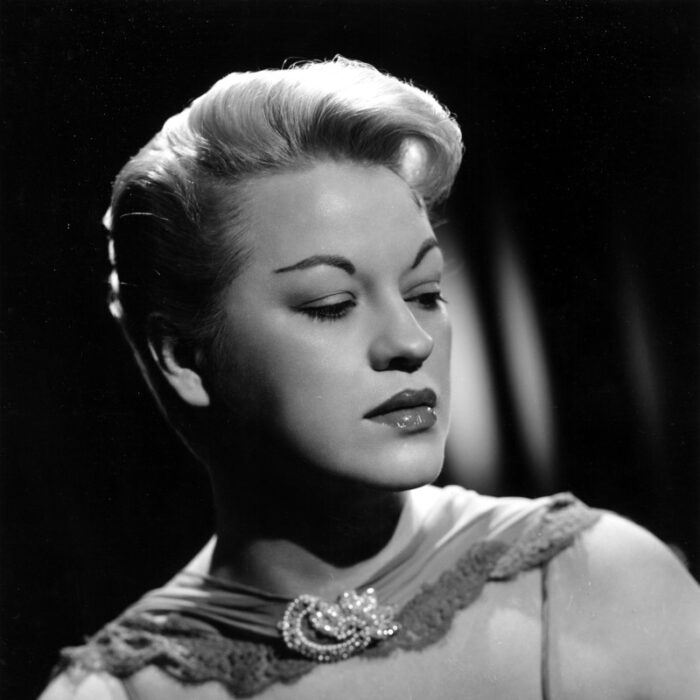
Mary Ann McCall was born in Philadelphia, Pennsylvania on 4 May 1919. As a child she had rickets, and used crutches. A doctor recommended dancing classes, which led her to a performing career. She began to work professionally in the late 1930s while still a teenager, initially making appearances as a dancer and singer with Buddy Morrow’s band
McCall landed her first band job inauspiciously with Tommy Dorsey in January 1939. When Dorsey singer Edythe Wright announced she was leaving the orchestra to get married, Dorsey selected the unknown McCall, then singing in her hometown, as Wright’s replacement. McCall’s tenure with the band lasted exactly one night.
Opening at a theater in Hartford, Connecticut, some reports at the time said McCall was booed off the stage, with the audience demanding Wright’s return. The real story, however, involved a contract dispute. Dorsey’s contract with the theater specified that the popular and well-known Wright was to appear, and when she didn’t the theater manager pressed the term. McCall was out, and Wright returned the next night, saying she was only on vacation and hadn’t really left the band. Some in the trade press suggested it may have all been a publicity stunt on Wright’s part.
Early Band Career
Whatever the circumstances revolving around McCall’s time with Dorsey, the attention she received from the incident worked in her favor, and she quickly landed a job with Woody Herman. In early December, she left Herman for Charlie Barnet’s orchestra, debuting with the band during their record-breaking run at the Apollo Theater. She remained with Barnet until June 1940. According to Barnet’s representative, McCall was put on notice that month so Barnet could bring in Harriet Clark to replace her. McCall took exception with that report, headlined “Bounced by Barnet” in Down Beat magazine with her picture prominently displayed underneath it. She wrote a letter to the editor stating that Barnet hadn’t put her on notice. According to McCall, she’d heard rumors that Barnet was seen around town with Clark, in whom he had a romantic interest, and she asked him if she should be concerned. He told her not to be, but she soon discovered that he’d lied to her and intended to replace her. McCall said she was the one who gave notice upon learning the truth.
After leaving Barnet, McCall joined Herbie Woods and his orchestra. By the first of August, though, she was on her own. She opened at Buffalo’s Century Theater on August 9th, set for a buildup by New York radio station WOR, part of the Mutual network. Bluebird, Barnet’s label, showed interest in signing her but nothing came of it, and her attempt at a solo career fizzled.
Also that August, McCall tipped Down Beat that she would marry Jimmy Dorsey in a couple of months—not the famous bandleader but an old acquaintance of hers from her hometown whom she had met again while singing with Woods. This Jimmy Dorsey was an aviator. A gossip columnist at the time, though, reported that she was marrying Jimmy Dorsey trumpet player Jimmy Blake.
In September 1940, McCall joined Tommy Reynolds’ orchestra, leaving in April 1941 to return to Barnet. By mid-1941, though, she had disappeared from the limelight, prompting Down Beat to put her name in their monthly “Where Is?” column. The answer was Philadelphia, where she appeared on radio station WCAU in August 1942 and in October joined Billy Marshall’s society orchestra at the Benjamin Franklin Hotel. She left Marshall in early March 1943 to sing with Reynolds again but by the end of the month she’d rejoined Barnet, who’d just organized a new band, where she initially shared female vocalist duties with Dell Parker. She remained with Barnet until at least July but was single again in September when it was rumored that Charlie Spivak had made her an offer. She rejoined Barnet once again in November when Virginia Maxey left. Barnet and McCall both appeared on the cover of Down Beat’s Christmas issue in a posed photo of Barnet stuffing war bonds down McCall’s stockings while she was wearing them.
Later Years
By January 1944, McCall was back on her own, singing in theaters, but in February she returned to Barnet one final time, staying only briefly. She had sufficiently disappeared by September that Down Beat once again asked where she was. She reappeared in February 1945 as part of Lew Gray’s orchestra in Los Angeles, and in mid-1946 she was with Allyn Cassel’s band. In September 1946, she joined Herman’s Herd once again. When Herman disbanded in December, she remained with the band’s Columbia label as part of their increase in popular jazz waxings, where she often worked with the Ralph Burns Orchestra. In late 1947, she joined Herman’s new progressive jazz band, staying into summer 1949. That year, she overwhelmingly topped Down Beat’s poll for best female band vocalist. While still a member of the Herd in late 1948 and early 1949 she also recorded solo on the Discovery label.
In 1949, she won the Down Beat Readers’ Poll for “Girl Singer (With Band)”. Billboard magazine reviewed her 1947 recordings of “Money is Honey” and “On Time”, praising her “torchy and scorchy pipes” and “real blues feeling.” Woody Herman recalled that “she was truly a great jazz singer.” In 1952, Jet magazine included McCall in a feature titled “Do White Singers Imitate Negroes?”
McCall married Herman tenor sax player and arranger Al Cohn in 1949. From then and into the 1950s, she recorded three albums under her own name and several with Charlie Ventura with whom she worked with in 1954-55,
She also recorded with Artie Shaw’s newly-reorganized Gramercy Five. McCall developed a serious heroin habit in 1949, eventually losing her home before being arrested in San Francisco on possession of narcotics in 1953 and subsequently spent 23 days in jail.
In 1954, she toured the United States with Stan Kenton’s Festival of Modern American Jazz. In 1960 she and the Barney Kessel Quintet played six nights in San Francisco. In 1973 she sang at an event in Sherman Oaks, sharing the stage with Sam Yorty, William Conrad, and Jerry Scoggins. In 1976 she performed at the Concord Summer Festival, with Jake Hanna‘s Kansas City Express. As late as 1985 she was still singing occasionally in clubs in Southern California. In 1987, she performed at a Woody Herman tribute concert just a few days before the bandleader’s death.
Mary Ann McCall passed away in 1994, age 75.
Appetizers