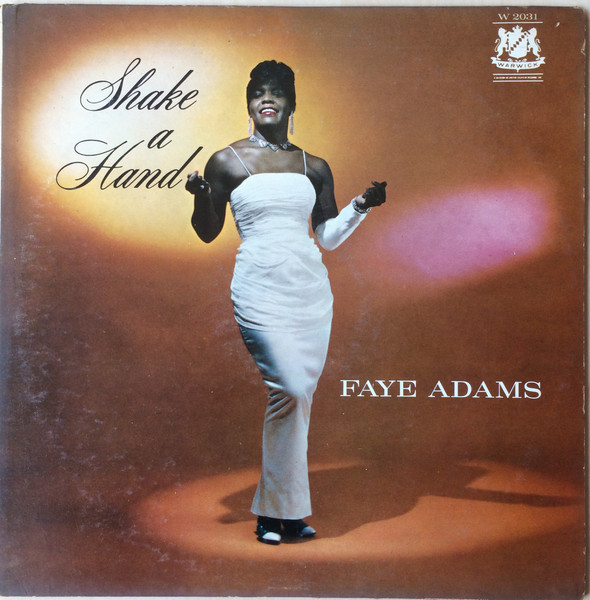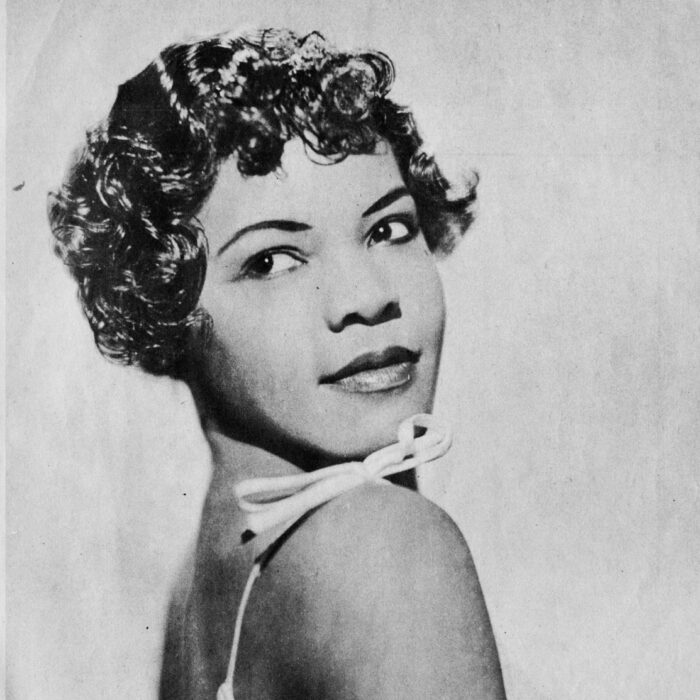
Faye Adams was from the Newark area of New Jersey, where she grew up performing gospel. “As long as I can remember, I was traveling around the country making appearances as a religious singer,” she recalled. Adams later began to make a name for herself in secular music as Faye Scruggs (her married name—her husband, Tommy Scruggs, also became her manager).
Adams’s big break came when Ruth Brown brought Count Basie and Marshall Royal to see her perform in Atlanta, likely in 1952. Royal in particular was so impressed with Adams that he sent her to see bandleader and arranger Phil Moore—who was called the “starmaker” for his help in providing musical training for stars including Betty Grable, Lena Horne, and Marilyn Monroe. Moore helped Adams find the connections she needed to advance her career. Moore said of Adams in 1953, “Faye can really please the folks who like their blues with a beat. Not only that, I feel that she’s going to develop into the top notch star in this bracket.”
Adams (at first still under the name Scruggs) began recording and touring with bandleader Joe Morris, producing some records for Atlantic. It was Morris who wrote the song “Shake a Hand” for her, and the record they produced of it was a massive hit on the R&B charts in 1953. The success of “Shake a Hand” precipitated the kind of chart crossover that helped to break rock and roll in 1955. The Chicago Defender reported of “Shake a Hand” that:
The turn, which has topped the nation for weeks in the ‘Rhythm and Blues’ category has begun to move onto the popularity charts usually reserved for the so-called “pop” tunes. … [Distributors] have been so impressed by this demand that they are calling for more sides by the “original ‘Shake a Hand’ girl” in record shops which ordinarily shy away from tunes labeled as “Rhythm und Blues.”
“Shake a Hand,” a slow ballad in Adams’s rendition, was perhaps too gentle to itself be considered rock and roll—although it was later covered by Little Richard, LaVern Baker, and Elvis Presley among others—something Adams herself recognized as the popularity of rock and roll took off. She told Cleveland’s Call and Post in 1957: “After cutting the record for ‘Shake A Hand,’ I decided to switch entirely to rock ’n roll.” Disc jockeys including Alan Freed did play her records and included her in the early canon of rock and roll, and by 1957, the Lackawanna Leader could note that Adams was “being called the female counterpart of Fats Domino” (the two performers had shared a bill at least once). She reached #1 on the Billboard R&B charts twice more in 1954, once with “I’ll Be True” and again with “It Hurts Me to My Heart”; newspapers also reported that her live performances were very well attended. She continued to tour regularly, both as a soloist on the club circuit and with R&B package tours through the rest of the decade.
While there are some isolated mentions of performances and a few recordings by Adams from the 1960s or later, it seems her career (at least under the name “Faye Adams”) slowed somewhat and she may have retired. In 1998, she was given a “Pioneer Award” by the Rhythm and Blues Foundation. There are no known obituaries.
Appetizers