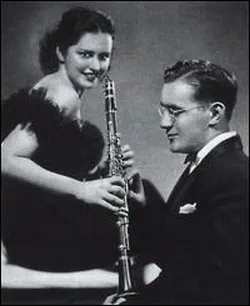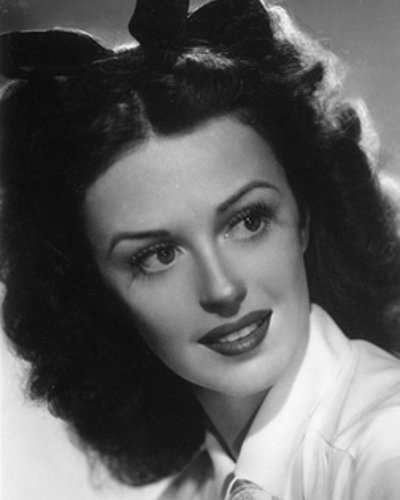
Considered one of the best vocalists of the swing era, Helen Ward is most remembered for her work with Benny Goodman’s orchestra during the mid-1930s. Singing on many of Goodman’s early hits, she helped set the tone for the emergence of swing as a national craze in 1935. Leaving Goodman at the end of 1936 to get married, Ward worked sporadically for the rest of her life, continuing to sing into the 1980s.
Born in New York City, Ward was the daughter of an Austrian immigrant father. She reportedly attended New York University before joining Nye Mayhew’s orchestra for her first professional singing job and then worked with Freddy Martin, Eddie Duchin, Rubinoff, and Enric Madriguera, recording with the latter in 1934. She also recorded with Ed Loyd’s orchestra in February 1934.
Goodman Years
In mid-1934, Benny Goodman chose Ward as the female vocalist for his new band. Goodman famously disliked vocalists, feeling that jazz should be instrumental only. He knew, though, that in order to have commercial appeal he needed them. He favored Ward, believing her to be the only vocalist who could properly sing swing. In addition to her sensuous stage presence and warm voice, Ward had a fine sense of musical timing.
Ward appeared with Goodman’s orchestra on the popular Let’s Dance radio program, a live music broadcast with featured a thousand people in its studio audience. The show opened with Kel Murray playing thirty minutes of sweet dance music and Xavier Cugat following with a Latin set. Goodman finished out the program with hot jazz. In between vocal numbers, Ward would join a set of studio dancers to help entertain the audience, pairing up with a male singer. The show aired on NBC Saturday nights, sponsored by the National Biscuit Company to help promote their new product—Ritz crackers. While a member of Goodman’s band, Ward also recorded with Harry Rosenthal’s orchestra in November 1934.
After the radio series ended, Goodman suffered a run of failed New York club appearances before taking off on a cross-country tour in 1935 where he encountered negative reaction all along the way until he reached Oakland. There, for the first time, the band scored a resounding success, followed by another at the Palomar Ballroom in Los Angeles. Radio broadcasts from the Palomar helped spread the excitement from coast-to-coast, and Goodman’s orchestra unexpectedly found itself the hottest in the country. The swing era had begun. White audiences were finally hooked.
Goodman never found a male vocalist he particularly liked. He constantly hired and fired them, often giving their numbers to Ward. As such, she became a key part of the orchestra’s sound and by extension the sound of the swing era itself. Early radio set lists tended to feature vocal numbers for half the show, though Goodman finally settled into a pattern of three vocal tunes each program, with Ward typically as the only singer.
Ward and Goodman dated on and off during her period with the band. Goodman was notoriously difficult to get along with. He lacked people skills, and his musicians often described him as cold, calculating, and blunt. During his “on” periods with Ward, he would bring her a white gardenia every day. When he drifted into an “off” period, he would typically ignore her. Ward told that once, during a time when they weren’t seeing each other, he caught her out with another man and quickly asked her to marry him. She refused. While she believed that he did genuinely like her, she also felt that he’d only proposed to keep her from leaving the band. Goodman’s fears finally came true in October 1936 when she met him at a restaurant to announce that she was leaving to marry wealthy jeweler and jazz patron Albert Marx. Goodman flung his dinner menu at her face.
Post-Goodman Career
Ward stayed with Goodman through the end of 1936, recording with the band in December. Though she no longer toured after her marriage, she continued singing, recording with Teddy Wilson in 1937 and Gene Krupa in 1938 on his orchestra’s first session. In 1939, she recorded with Bob Crosby’s band and appeared on their Camel Caravan radio program. She recorded with Wilson again as well as Joe Sullivan in 1940 and both Harry James and Matty Malneck in 1941.
Divorcing Marx in late 1942, Ward returned to full-time vocal work after the new year, signing with the Columbia label and joining Hal McIntyre in February 1943, where she stayed until October. Rumors that month had her working with either Harry James or with Goodman again, but neither panned out. She was almost ready to sign a contract with James but their deal fell through at the last minute for unrevealed reasons. James signed Judy Williams instead, though when Williams left at the end of December 1943, Ward replaced her, signing a year-long contract. James, however, was facing the possibility of entering the service at that time and in April 1944 broke up his band in anticipation. After James was unexpectedly reclassified 4-F, he quickly formed a new band in May with Kitty Kallen as vocalist. Ward filed suit against James for $8,250, claiming that he had fired her without due cause with seven months to go on her contract. They settled out of court, with James paying Ward an undisclosed but “sizeable chunk of dough.”
After her departure from James, Ward went back into semi-retirement. Aside from recording a V-Disk with Red Norvo in 1944, she went unheard until July 1946 when she appeared on Goodman’s radio program. In September of that year she briefly joined the staff of New York radio station WHN before drifting back to private life with only sporadic singing work. In 1952, she recorded an album of Dixieland tunes with Wild Bill Davison, and in 1956 she sang with Larry Clinton on an album recreating his hit tunes. She also made a number of later recordings as a solo artist. In 1979, she came out of retirement to sing in New York clubs. She eventually retired to Falls Church, Virginia.
Ward remarried twice, first to man named Newton in 1953, and then to William Savory in 1971. Helen Ward passed away in 1998 at age 84.
Appetizers